The Art of Gaslighting
Nathan Aherne developed a specific theory about gaslighting, wrote a book explaining the mechanism from the inside, and has continued to apply that thinking to identity, influence, power, perception and business.
The argument is not that he read widely in psychology and adopted a framework. It is that the accepted definition of gaslighting describes the effect and misses the mechanism — and that distinction has consequences.
The definition is wrong
Accepted definition
Gaslighting is generally described as manipulation that makes someone question their perception, memory or reality.
Nathan’s proposition
That definition focuses on the result and misses the mechanism. Nathan argues that the accepted definition is wrong — not as a matter of etiquette, but as a description of how the tactic works.
The accepted definition of gaslighting usually describes it as manipulating someone until they doubt their own perception, memory or reality.
Nathan’s argument is that this describes the effect, not the mechanism.
In Patrick Hamilton’s play Gas Light, Bella already carries a fear that she may inherit her mother’s insanity. Her mother died insane; Bella is more than half convinced the same fate may be hers. Manningham does not create that fear from nothing. He speaks into it, constructs circumstances that appear to confirm it, and uses the fear to control her.
Later films and modern definitions, in Nathan’s view, focused on the visible effect — questioning reality or sanity — and missed the role of the pre-existing fear.
Nathan’s proposition is that gaslighting works by finding an existing fear, reinforcing it and making that fear appear true.
The person may then question their memory, judgement or sanity, but those are consequences of the manipulation rather than the mechanism itself.
Why the distinction matters
Nathan argues that one of the problems with the accepted definition is that it can leave people trying to defend “their reality.”
But a story about reality is still a story.
Recovery requires the willingness to discover that some of what you believed may have been wrong. That does not mean the manipulation did not happen. It means separating what actually happened from what fear, memory, interpretation and identity added to it.
Nathan’s view is that freedom does not come from proving that your version of reality was right. It comes from no longer needing your story to be right.
- What actually happened?
- What did I add to what happened?
- What was I afraid was true?
- What behaviour did that fear produce?
- What happens if I allow the fear to exist without letting it control me?
When the manipulator is no longer required
Once a fear has been reinforced strongly enough, the original manipulator may no longer need to do much.
The person can begin interpreting new events through the same fear and generating their own confirming evidence.
Nathan refers to this as self-gaslighting.
Someone who already fears that they are stupid, unwanted, weak, incompetent, unlovable or unstable can start treating ambiguous events as proof. The fear becomes the filter. The person then continues the mechanism themselves.
Nathan’s work argues that breaking gaslighting requires seeing the fear and the interpretation separately from reality. This is Nathan’s framework — not a clinical diagnosis.
What feels real is not always what happened
Human beings can generate internal experiences — through imagination, memory, prediction and fear — that feel compellingly real.
The brain normally has mechanisms for distinguishing internally generated experience from external events, but that distinction is not perfect.
Nathan’s work is interested in what happens when a fear becomes strong enough that internally generated meaning starts being treated as external reality.
A fear does not have to be true to produce real behaviour. A memory does not have to be complete to feel convincing. An imagined outcome can create the same urgency as something happening in front of you.
That gap between reality and the human experience of reality is where manipulation becomes possible. Nathan’s work on gaslighting is ultimately about understanding that gap.
The Art of Gaslighting
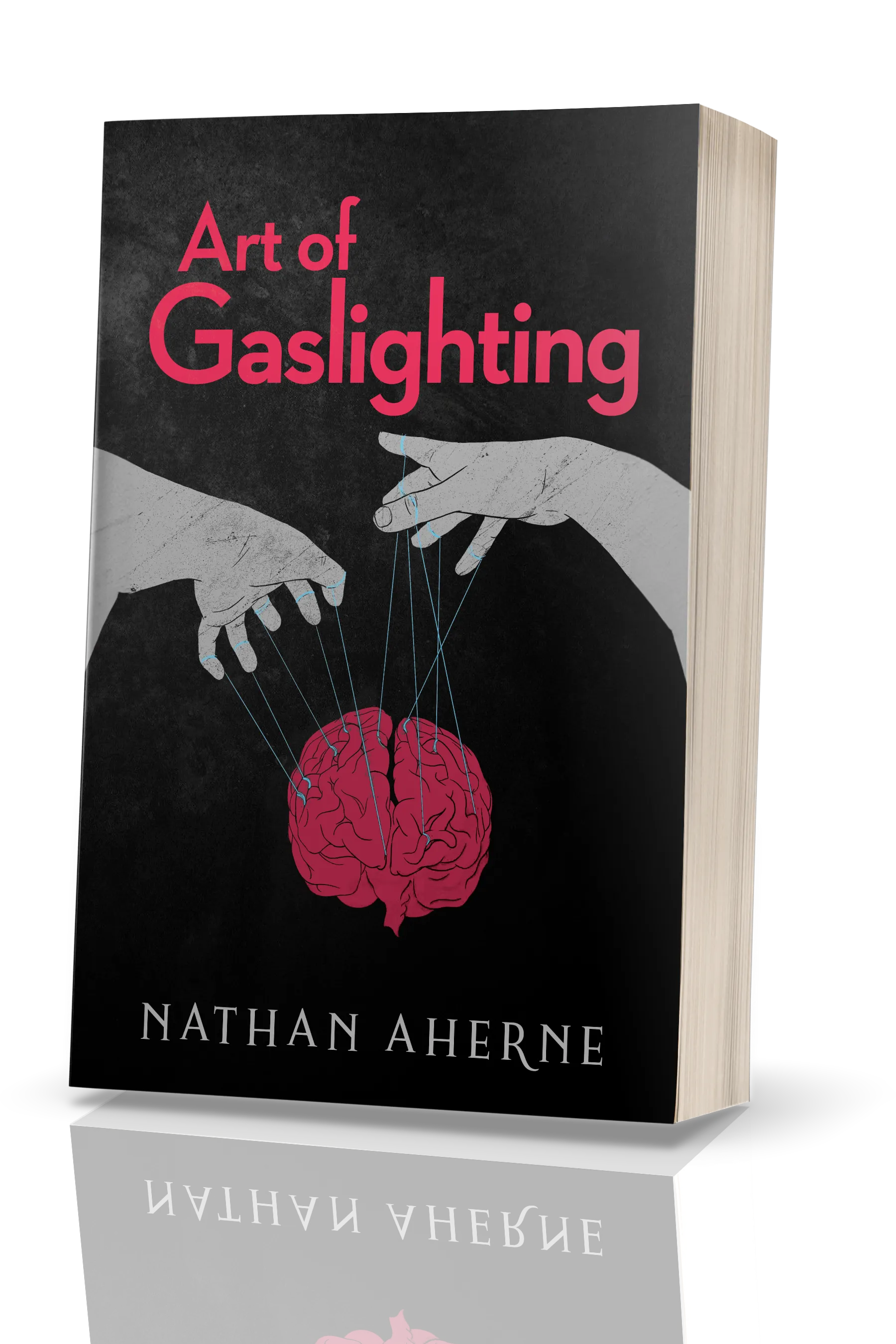
Nathan wrote The Art of Gaslighting to explain the mechanism from the inside.
Most books on gaslighting explain how to recognise it, recover from it or protect yourself from it. The Art of Gaslighting does something different. It explains what Nathan believes gaslighting actually is and then shows how the mechanism works.
The book is deliberately uncomfortable because understanding a manipulation technique requires looking at how it is performed, not only at what it feels like to experience it.
Nathan’s published proposition is that it is the first book written specifically on how to gaslight people. The point was not to encourage abuse. It was to bring the mechanic into the open so it can be recognised, resisted or dismantled.

Why this matters outside gaslighting
Nathan’s interest in gaslighting is part of a much broader interest in human behaviour.
Businesses, markets, brands, valuations, organisations and authority all depend on human beings assigning meaning to things and then acting on that meaning. People do not respond only to facts. They respond to what they believe the facts mean.
The same person can interpret the same event completely differently depending on fear, identity, incentives, status and prior experience.
That is why human behaviour runs through Nathan’s work as an investor, adviser and operator.
- Almost Everything Exists Because Human Beings Say So
- When the People Become the Problem
- Bare Metal
- The False Peak